presscorner-builder


Build and maintain research-ready datasets from the European Commission Press Corner — every press release, speech, and statement since 1985 (plus some records back to 1975), in one Parquet file.
The Press Corner is the European Commission’s press release database. presscorner-builder turns it into a clean, citable, always-updatable dataset for social science research. You can define your own sub-corpus (by date, type, keyword, commissioner, or policy area) in a small YAML file, or download the full pre-built corpus and top it up to today with one command.
No web scraping knowledge required. If you can run two commands in a terminal, you can use this.
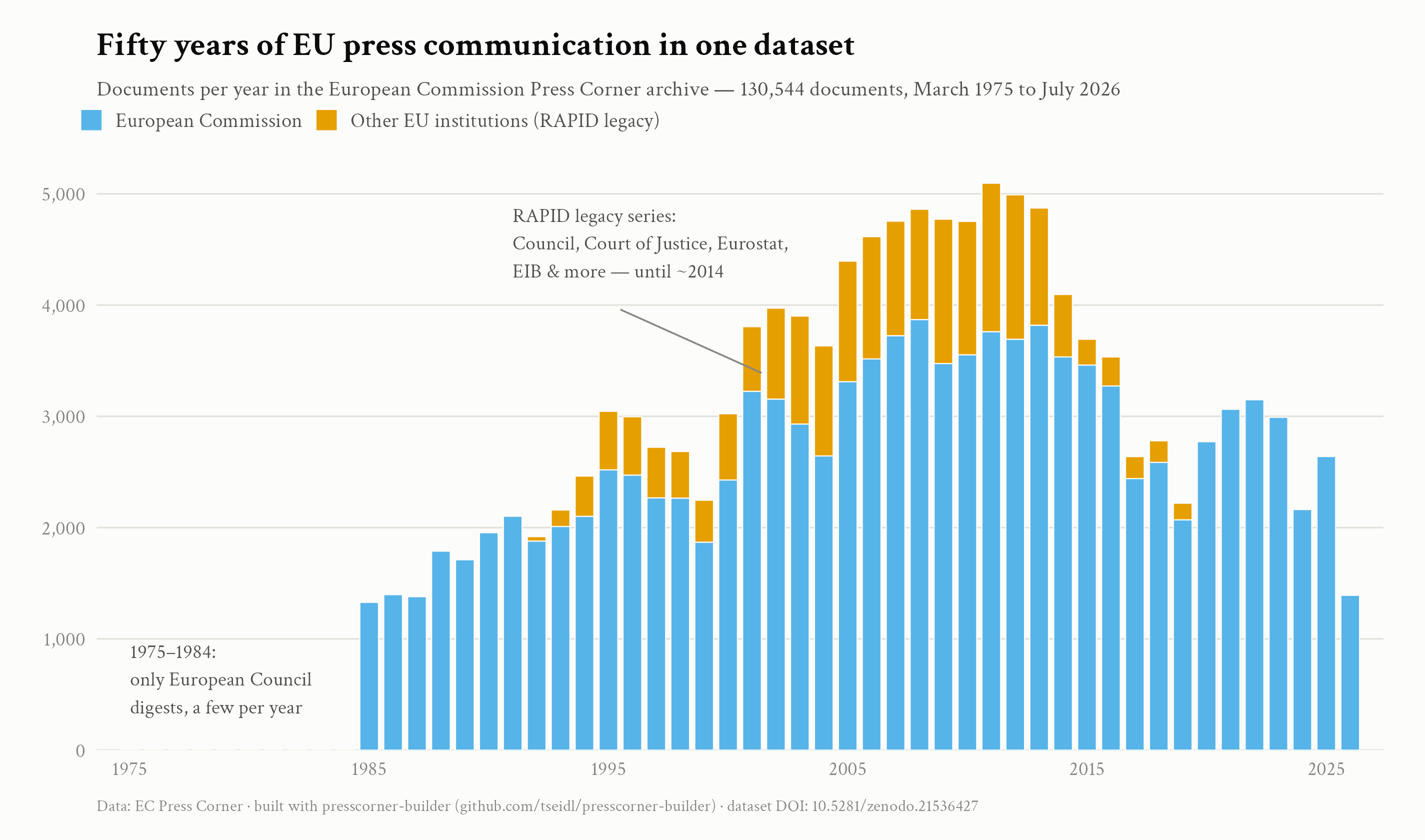
130,544 documents · 1975-03-11 to 2026-07-24 · 32 document types · EN language edition
The published dataset is refreshed every few months. If you don’t want to wait for the next refresh, presscorner update brings your local copy to today in minutes — whatever the current cut-off.
Quick start
pip install presscorner-builderThere are two ways to use it.
1. Build your own corpus. Describe the corpus you want in a small YAML file (presscorner init writes a template):
metadata:
  project_name: "Von der Leyen climate speeches"

data:
  mode: descriptive
  document_types: [SPEECH, STATEMENT]
  start_date: 2019-12-01
  keywords: ["climate"]

output:
  output_directory: ./output
  dataset_name: vdl-climate
presscorner build config.yamlThis produces output/vdl-climate.parquet plus a metadata sidecar recording exactly how the corpus was built (config hash, package version, run date) — share the YAML in your replication package and the corpus is fully reproducible. If you already know which documents you want, use mode: fixed with a list of reference numbers instead.
2. Or take the complete dataset. Download the pre-built full corpus and top it up to today:
presscorner download   # fetch the published full dataset (~460 MB)
presscorner update     # top it up from its cut-off date to today
That’s it. data/press-corner.parquet now contains the complete corpus. Load it in R or Python:
library(arrow)
docs <- read_parquet("data/press-corner.parquet")
import pandas as pd
docs = pd.read_parquet("data/press-corner.parquet")Already have a copy of the dataset from a colleague? Drop it in data/ and run presscorner update — the tool reads the file itself to see where it stops and fetches only what’s newer. Older versions produced by the predecessor scraper are migrated automatically.
What’s in the dataset
The Press Corner is the successor of RAPID, the press database of the Commission’s Spokesperson’s Service, whose records reach back to 1985 — the old europa.eu/rapid address still redirects into the Press Corner today. The current website only advertises nine document types, but the archive behind the API still contains the full RAPID legacy — including press material from the Council, the Court of Justice, and other EU institutions, and digests of European Council conclusions back to the very first European Council (Dublin, March 1975). presscorner-builder collects all of it. To our knowledge this is not documented anywhere else.
| Code | What it is | Documents | Coverage |
|---|---|---|---|
IP |
Press release | 51,303 | 1985–2026 |
SPEECH |
Speech | 24,886 | 1985–2026 |
MEMO |
Memo / background note | 11,421 | 1985–2022 |
BIO |
Spokesperson’s briefing (legacy) | 8,620 | 1985–2000 |
MEX |
Daily news (Midday Express) | 6,175 | 2001–2026 |
PRES |
Council of the EU press release (legacy) | 4,479 | 1992–2013 |
STATEMENT |
Statement | 3,944 | 2014–2026 |
STAT |
Eurostat release (legacy) | 3,409 | 2001–2019 |
PESC |
CFSP declaration (legacy) | 2,452 | 1994–2013 |
BEI |
European Investment Bank (legacy) | 2,106 | 2001–2014 |
CES |
European Economic and Social Committee (legacy) | 2,059 | 1995–2014 |
CJE |
Court of Justice press release (legacy) | 1,691 | 1994–2014 |
COR |
Committee of the Regions (legacy) | 1,223 | 1995–2014 |
P |
Early press note (legacy) | 960 | 1985–1995 |
QANDA |
Questions and answers | 945 | 2019–2026 |
AC |
News article | 937 | 2014–2026 |
FS |
Factsheet | 834 | 2015–2026 |
CLDR |
Calendar (legacy) | 715 | 2009–2025 |
AGENDA |
Weekly agenda (legacy) | 622 | 2005–2020 |
ECA |
Court of Auditors (legacy) | 470 | 1995–2014 |
EO |
European Ombudsman (legacy) | 330 | 2000–2014 |
DOC |
European Council conclusions digest (legacy) | 294 | 1975–2013 |
OLAF |
European Anti-Fraud Office (legacy) | 183 | 2001–2015 |
EDPS |
European Data Protection Supervisor (legacy) | 126 | 2005–2014 |
WM |
Week in the media (legacy) | 105 | 2014–2021 |
INF |
Infringement decisions | 71 | 2019–2026 |
READ |
Read-out | 57 | 2020–2026 |
DN |
Daily news bulletin (legacy) | 55 | 2005–2005 |
EPSO |
European Personnel Selection Office (legacy) | 35 | 2003–2009 |
COUNTRY |
Country information (legacy) | 21 | 2019–2022 |
ETW |
Enterprise Europe Network (legacy) | 14 | 2011–2012 |
TRANS |
Transcript (legacy) | 2 | 2012–2012 |
Two honest caveats:
- The legacy series ended around 2013–2015, when the other institutions launched their own newsrooms. For those institutions this is a historical archive, not ongoing coverage. The Commission’s own types (
IP,SPEECH,STATEMENT,MEX,QANDA, …) are current and continuously updated. - Rich metadata is a recent phenomenon. Policy areas, commissioner attribution, places, and subtitles were introduced with the modern content system and never backfilled. What is consistent across the whole archive is the core: reference, date, title, and full text. Plan your research design accordingly:
| Field | 1980s | 1990s | 2000s | 2010s | 2020s |
|---|---|---|---|---|---|
| Full text | 100% | 100% | 100% | 100% | 98% |
| Subtitle | 0% | 0% | 0% | 27% | 89% |
| Summary | 0% | 0% | 0% | 15% | 32% |
| Policy areas | 0% | 0% | 0% | 27% | 100% |
| Spokespersons | 0% | 0% | 0% | 15% | 56% |
| Commissioners | 0% | 0% | 0% | 31% | 85% |
| Place | 0% | 0% | 0% | 39% | 89% |
Why is full text not 100% in the 2020s? Almost all of the gap is factsheets (FS): these are designed as visual PDF documents, so their pages have no body text to extract. Every one of them carries a working pdf_url pointing to the actual content.
Keeping the dataset complete: audit
Scrapes fail silently: connections drop, servers hiccup, and you end up with holes you never notice. Two safeguards protect against this:
- All fetching happens in calendar-month windows, so an interruption costs at most one month, and every run is resumable — failed windows and documents are remembered and retried on the next run.
presscorner auditcompares, month by month, how many documents the EC API reports against how many your local file contains, and prints any mismatch.presscorner audit --fixre-fetches the deficient months.
presscorner audit          # find holes
presscorner audit --fix    # repair them
Commands
| Command | What it does |
|---|---|
presscorner download |
Fetch the published full dataset (shows version and cut-off date) |
presscorner update |
Incrementally extend your local dataset to today |
presscorner build config.yaml |
Build a YAML-defined sub-corpus |
presscorner audit [--fix] |
Check (and repair) completeness against the API |
presscorner status |
Show counts, date range, cut-off, pending retries |
presscorner export --by-type |
Optional per-type Parquet files (speeches.parquet, …) |
presscorner init |
Write an example YAML config |
All commands take --data-dir (default ./data) and are safe to interrupt and re-run.
Data schema
One row per document.
| Column | Description |
|---|---|
document_id |
Unique ID (ip_26_301) |
reference |
Official reference (IP/26/301) |
doc_type, doc_type_name |
Type code and label |
title, subtitle, summary |
Title fields (subtitle/summary mostly post-2010) |
date |
Publication date (YYYY-MM-DD) |
publish_datetime |
Exact publication timestamp (recent documents only) |
place |
Location, e.g. “Brussels” (recent documents only) |
language, original_language |
Language edition and original language |
commissioners |
Attributed commissioner(s) — the speaker, for speeches (recent only) |
spokespersons |
Press contacts listed on the document (recent only) |
policy_areas, policy_codes |
Policy area labels and codes (recent only) |
full_text |
Complete text, HTML stripped |
url, pdf_url |
Links to the document page and PDF |
detail_ok |
Whether the full document fetch succeeded (a few always fail server-side) |
scraped_at |
Retrieval timestamp |
Multi-valued fields are "; "-joined strings. By default the English edition is collected; update/build accept other language codes but the published dataset is English.
Dataset versioning and citation
The full dataset is published on Zenodo with a versioned DOI; versions are named by cut-off (v2026.07 = complete through July 2026). presscorner download always tells you which version you got. Whatever the published version, presscorner update brings your local copy to today.
If you use the dataset or the package, please cite both:
@dataset{seidl_presscorner_data,
  author    = {Seidl, Timo},
  title     = {EC Press Corner Complete Document Dataset (1975--2026)},
  publisher = {Zenodo},
  doi       = {10.5281/zenodo.21536427},
  note      = {Dataset version v2026.07}
}

@software{seidl_presscorner_builder,
  author = {Seidl, Timo},
  title  = {presscorner-builder: research-ready datasets from the EC Press Corner},
  url    = {https://github.com/tseidl/presscorner-builder},
  doi    = {10.5281/zenodo.21538765}
}
The dataset DOI above is the Zenodo concept DOI, which always resolves to the latest version. For reproducibility, cite the version DOI of the release you actually used (listed on the Zenodo record; for v2026.07 it is 10.5281/zenodo.21536428) and state the version number.
For maintainers
- Refresh cycle: every few months, run
presscorner update && presscorner audit --fix, thenpython scripts/update-readme-stats.py, publish the new parquet as a Zenodo version, and updatedataset-manifest.json(version, cut-off, URL, sha256). - Scraping is polite by design: ≥1s request delay, honest User-Agent, exponential backoff, no parallel requests.
License
MIT. The documents themselves are © European Union — reuse is governed by the Commission’s reuse policy (CC BY 4.0 for most content).